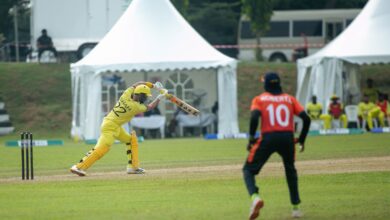
ZIMBABWE Women shattered a significant barrier in their international journey by defeating West Indies by four wickets at Harare Sports Club to record their first victory in the ICC Women’s Championship on Sunday.
Nyasha Gwanzura made a career best four for 33 before returning with an unbeaten 18 in a tense chase as Zimbabwe hunted down 140 in 40.5 overs to level the three match ODI series at one apiece.
It was a stirring response from the hosts, who had been beaten by 99 runs in Thursday’s opening match, and only their second ODI victory over a Full Member nation.
More importantly, Zimbabwe finally have an ICC Women’s Championship win against their name.
Gwanzura was at the heart of it, but this was a victory built around a collective bowling performance, five catches behind the stumps from Modester Mupachikwa and enough composure with the bat to survive a West Indies fightback.
West Indies captain Hayley Matthews, fresh from her imposing 182 in the opening ODI, won the toss and elected to bat, but Zimbabwe ensured there would be no repeat of Thursday’s run feast.
Michelle Mavunga provided the first breakthrough in the second over when Realeanna Grimmond edged behind for four, Mupachikwa completing the first of what would become a busy afternoon with the gloves.
Matthews and the experienced Stafanie Taylor briefly threatened to settle the innings with a 47 run second wicket partnership.
Then Zimbabwe ripped through the middle order.
Gwanzura removed the dangerous Matthews for 26, caught behind by Mupachikwa, and Francisca Chipare struck twice in three deliveries.
Shemaine Campbelle was caught by Gwanzura for three before Chinelle Henry departed without scoring, substitute fielder Christina Mutasa taking the catch.
West Indies had tumbled to 63 for four and Zimbabwe could sense their opportunity.
They did not release the pressure.
Gwanzura had Jannillea Glasgow caught by Beloved Biza for one, found the edge of Zaida James for three and then trapped Aaliyah Alleyne lbw for four.
A West Indies side that had been relatively comfortable at 56 for one had collapsed to 88 for seven.
Taylor stood between Zimbabwe and complete control.
The veteran batter attempted to hold the innings together with a patient 47, but Mavunga eventually found her edge and Mupachikwa did the rest.
When Mavunga also removed Afy Fletcher for 15, again caught by Mupachikwa, West Indies were 113 for nine.
Ashmini Munisar offered some late resistance with an unbeaten 20, adding 26 for the final wicket with Karishma Ramharack before Olinder Chare bowled Ramharack for five.
West Indies were dismissed for 139 in 39.3 overs.
Gwanzura’s four for 33 was the headline performance, while Mavunga claimed three for 36 and Chipare returned an excellent two for 16.
Behind them, Mupachikwa completed five catches in a polished wicketkeeping display.
A target of 140 appeared modest, but with history within touching distance, Zimbabwe still had to negotiate the pressure of the chase.
Mupachikwa and Kelis Ndhlovu gave them precisely the start required.
Rather than become consumed by the occasion, the pair patiently blunted the West Indies attack and put together a 67 run opening stand.
Mupachikwa was the more aggressive, striking seven boundaries in her 38, while Ndhlovu played the supporting role.
For a while, Zimbabwe appeared to be cruising.
Alleyne trapped Mupachikwa lbw at the end of the 17th over. Munisar then removed Chipo Mugeri Tiripano for a duck before Alleyne struck again to dismiss Ndhlovu for 30.
From 67 without loss, Zimbabwe had suddenly slipped to 70 for three.
The visitors had found a route back into the contest.
Biza and captain Josephine Nkomo responded with an important 30 run partnership, taking Zimbabwe to three figures before Fletcher bowled Biza for 14.
When Fletcher trapped Chiedza Dhururu lbw for two, the hosts were 105 for five.
Thirty five runs were still required and West Indies had dragged themselves firmly back into the contest.
Nkomo refused to panic.
The Zimbabwe captain found an equally determined partner in Gwanzura, whose work for the day was far from finished.
Together they added 28 precious runs, gradually reducing the equation and carrying Zimbabwe to within seven of victory.
There was one final twist when Nkomo fell for 30 in the 40th over.
Zimbabwe were six wickets down and the finish line, although close, still had to be crossed.
Gwanzura took responsibility.
She struck Fletcher for four in the following over and then collected a single before Mavunga scored the two runs that carried Zimbabwe to 140 for six.
The celebrations told their own story.
Gwanzura walked off unbeaten on 18 having first dismantled West Indies with the ball and then helped ensure the work was not wasted with the bat.
Munisar finished with two for 15, Alleyne two for 27 and Fletcher two for 37, but West Indies had simply not made enough runs after Zimbabwe’s bowlers seized control of the first innings.
For Zimbabwe, the significance stretched beyond levelling the series.
Their first ICC Women’s Championship victory represents another marker in the development of a side seeking to establish itself against the leading nations in the women’s game.
Thursday had belonged to West Indies and Matthews.
Three days later, Zimbabwe had their answer.
And after making history on Sunday, they return to Harare Sports Club on Wednesday with another prize within reach.